RMPD
RMPD questions, answers and PUESC rejection codes
Answers to the most common questions about an RMPD filing, with the legal basis and the real PUESC rejection codes ranked by frequency from our own data.
Published · Author: Makaiev Kostiantyn Oleksandrovych, founder of Sigil RMPD

A dispatcher filled in an RMPD filing ten minutes before departure. The sender's name was pasted from an email, and one Cyrillic character stayed behind where a Latin one belonged. PUESC answered with the code R01.CodeLatin and named the field GoodsSenderName. The filing was refused, the truck stood still, and the cause sat in a single character that no screen distinguishes.
RMPD is the filing a non-EU carrier sends to the Polish monitoring register before entering Poland. Below are the questions carriers ask most often, with the legal basis and with the codes the register actually refuses by.
In short: across our own platform the register refused 54 filings out of 410 sent between 24.06.2026 and 13.10.2026, roughly one in eight · the most frequent refusal is not a carrier error at all, it is the code R16.RMPD about an unsupported message · a reference number is valid for 10 days from the day it is assigned, not from the declared start of carriage (art. 11 ust. 1 of the SENT Act) · a missing filing where a permit is required means the journey counts as performed without a permit (art. 28b ust. 10 of the Road Transport Act), separately from the 12,000 zł penalty · a gap in geolocation transmission is a separate penalty of 10,000 zł (Annex 3, item 3.2b) · penalties from one roadside check cannot exceed 12,000 zł, while a check at the company itself reaches 30,000 zł depending on the number of drivers (art. 92a ust. 3 and 5) · the driver is obliged to refuse to set off without a reference number (art. 28c ust. 2).
An RMPD filing is required for every separate transport operation across Polish territory, and an empty run and a transit journey both count. Data moves from the CMR one to one, because the penalty falls on the discrepancy between the filing and the driver's papers. The costliest mistake is 12,000 zł, about 138,000 hryvnia at the NBU rate of 11.52 ₴/zł on 14.10.2026, and that single mistake exhausts the whole roadside ceiling.
Is a filing required in this case
A filing is required of every foreign carrier entering Polish territory as part of an international carriage of goods, including a carrier that an international agreement exempts from holding a permit. Art. 28b ust. 1 of the Road Transport Act lists both cases in one sentence: where a permit or an ECMT permit is required, and where an agreement waives it. An exemption from the permit is not an exemption from the filing, and that is the most widespread misunderstanding in the subject.
Is a filing required for an empty run across Polish territory? Yes. The duty attaches to carriage by a vehicle rather than to the presence of cargo, and art. 28b ust. 3 pkt 8 expressly requires a statement of whether the carriage runs with or without a load. The field exists precisely because an empty journey is registered too.
Is a filing required for transit with no unloading in Poland? Yes. Transit is the same journey across Polish territory, and the provision makes no exception for a route without a single Polish point.
Is a filing required for a van with a permissible gross weight of 3.5 t? Yes. The Road Transport Act does not apply to the carriage of goods only where the permissible gross weight does not exceed 2.5 t (art. 3 ust. 1 pkt 2a), while the 3.5 t limit in pkt 2 of the same paragraph governs national transport alone. What counts is box F.1 of the registration certificate, the permissible weight, not the unladen weight.
How many filings does one trip take
A separate filing goes with every transport operation, and the statute states the test precisely. Art. 28b ust. 8 of the Road Transport Act says that where one carriage involves several transport operations requiring more than one permit, or for which the legal basis of the exemption is different, each such operation requires a separate filing. For cabotage, art. 28b ust. 9 requires a separate filing per operation with no further conditions.
From that follows the practical rule usually given with no authority behind it. Where a trip combines bilateral Ukraine-Poland carriage with anything else, the basis of exemption stops being shared, and the operations split into two filings. That is exactly where an ECMT carnet becomes necessary, because the agreement exemption does not cover the whole route.
Several loadings in one country sit under one basis of exemption and one filing. Different countries of unloading are different operations.
Where the data in a filing comes from
The sender and the consignee come from boxes 1 and 2 of the CMR consignment note, not from the invoice and not from the export declaration. Art. 28b ust. 3 pkt 2 and 3 of the Road Transport Act requires a name and an address of residence or seat for each of them, and nothing more. The place of unloading is a separate field taken from box 3, and it may well differ from the consignee's address in box 2.
One point deserves attention because no competing text carries it. A tax identifier is required by the statute for the carrier alone (art. 28b ust. 3 pkt 1 lit. c), while for the sender and the consignee the provision prescribes no identifier whatsoever. The identifier fields for those two parties are a requirement of the portal and of the XSD schema, not of the statute, which is why searching the Act for rules on filling them yields nothing. How the consignment note maps onto the form is set out in a separate piece on moving CMR fields into an RMPD filing.
The number of the transport document is stated only where such a document is required (art. 28b ust. 3 pkt 9). Inventing a number is not allowed, because it has to match the paper in the cab.
How long a reference number lasts and what to do when it expires
A reference number is valid for 10 days from the day it is assigned, which art. 11 ust. 1 of the SENT Act states directly. The count runs from the day the number is assigned rather than from the declared start of carriage, so a filing submitted a week ahead leaves three days for the trip itself. Our own data confirm it: in a refusal carrying the code R06.StartEndTransportDate the portal names the maximum permitted end date itself, and that date stands nine days from the day the request arrived.
Where the term expires mid-trip, carriage continues once a new filing has been sent and a new number obtained (art. 11 ust. 2 of the SENT Act). The new filing is not a duplicate: art. 28b ust. 4 of the Road Transport Act requires it to state the previous reference number and the place where the continuation of carriage begins. Extending the old filing by editing the date does not work, and the reason sits below, in refusal R15.
Which rejection codes arrive most often
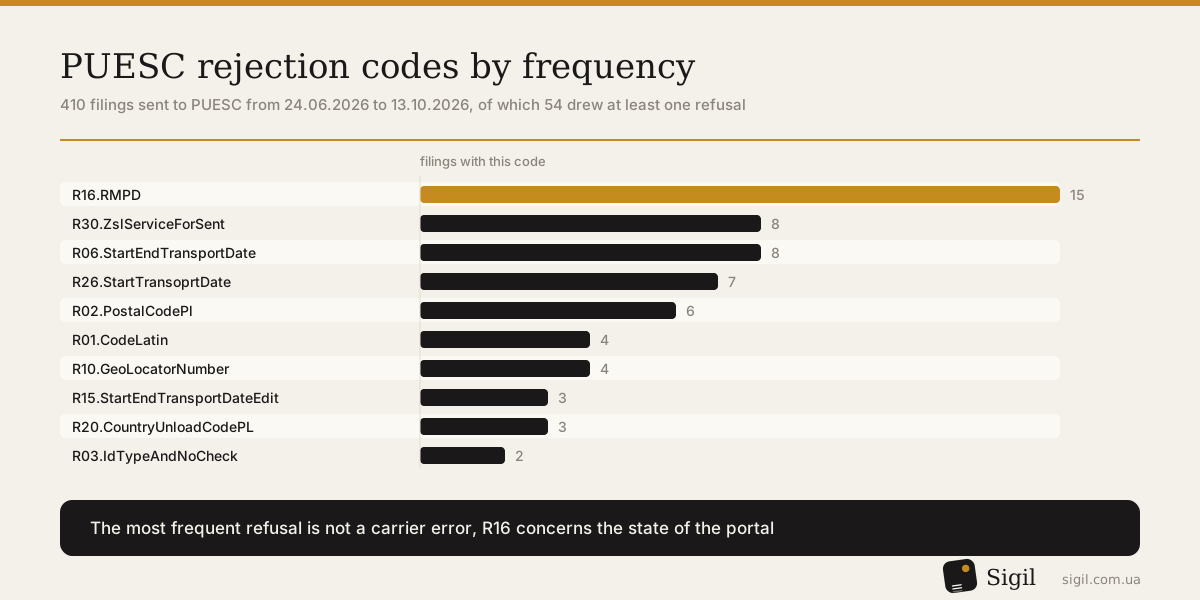
The register refuses by code, and the code says more than the message text. Below are the codes from real PUESC responses to our filings, ranked by how many filings met them: 410 filings the platform sent to PUESC over the period from 24.06.2026 to 13.10.2026, of which 54 drew at least one refusal. The rows add up to more than 54, because one filing sometimes catches two different codes.
| Code | What it actually means | Filings |
|---|---|---|
| R16.RMPD | The portal does not support the message sent at that moment; nothing is wrong with the data | 15 |
| R30.ZslServiceForSent | The locator number is correct but not activated for position reporting in SENT | 8 |
| R06.StartEndTransportDate | The end date is later than the maximum permitted, that is beyond the ten-day limit | 8 |
| R26.StartTransoprtDateNotBeforeToday | Cancellation fails because the start date of carriage already lies in the past | 7 |
| R02.PostalCodePl | The Polish postal code is wrong, most often missing the hyphen | 6 |
| R01.CodeLatin | A field holds a character outside Latin1 with Polish letters | 4 |
| R10.GeoLocatorNumber | The locator number has the wrong format | 4 |
| R15.StartEndTransportDateEdit | A start date already in the past cannot be changed | 3 |
| R20.CountryUnloadCodePL | Unloading is in Poland while the EndInsidePL section was left empty | 3 |
| R03.IdTypeAndNoCheck | The identifier type reads BRAK while the number holds something else | 2 |
| R18.CountryLoadCodeNotPL | Loading is outside Poland while the StartInsidePL section was filled in | 1 |
| R21.CountryUnloadCodeNotPL | Unloading is outside Poland while the ExitFromPoland section was left empty | 1 |
| R14.ExitFromPoland | A place of exit from Poland is given without the mandatory road number | 1 |
What these codes do not say outright
The portal sends code R26 with a typo in its own name, StartTransoprtDate instead of StartTransportDate. Searching for it online in the corrected spelling leads nowhere, and that is the only reason such a detail belongs here.
The most frequent refusal is not the carrier's fault. R16.RMPD, with its message that the transmitted message is not supported, concerns the state of the portal rather than the content of the filing; in our data the code met 15 filings between 3 July and 20 August 2026. The right response is to send again, not to edit the data. A full breakdown of each code with its list of fields sits in the piece on a PUESC refusal to register a filing.
Four codes in the table check the consistency of sections rather than the value of a field: R14, R18, R20 and R21. One logic runs through all four. Poland as the country of unloading requires a filled EndInsidePL section and forbids ExitFromPoland, a country of unloading outside Poland requires exactly the reverse, and a stated place of exit from Poland pulls a mandatory road number with it.
Can a filing be corrected or cancelled
Correction works while the date the correction concerns has not slipped into the past. The refusal R15.StartEndTransportDateEdit arrives precisely when the date declared in the original filing is already earlier than today: the portal answers that for this reason it cannot be changed. The duty to update the data does not disappear, because art. 8 ust. 1 of the SENT Act requires it without delay, while data about the goods themselves are not subject to update (art. 8 ust. 2).
Cancellation works while the start date of carriage has not arrived. Refusal R26 says so literally: the start date of the carriage of goods cannot be earlier than the current date at the moment the transport is cancelled. In our data the code met seven filings, and it is the most frequent refusal caused not by a field error but by a late decision.
Where carriage never began at all, the statute offers a different and simpler route. Art. 8 ust. 3 of the SENT Act requires the filing to be updated with information that the carriage of goods has been abandoned.
What a mistake costs and who pays
A missing filing and a filing with incomplete data or data inconsistent with the facts carry the same penalty of 12,000 zł, on the same basis: Annex 3, item 3.2a to the Road Transport Act. A total across several breaches is computed at once by the SENT and RMPD penalty calculator.
A gap in geolocation transmission is a separate penalty of 10,000 zł under Annex 3, item 3.2b, because art. 10a ust. 1 of the SENT Act requires current data to be transmitted throughout the entire route of carriage. The driver carries two penalties of their own, 1,500 zł for failing to present the reference number and 2,000 zł for a locator switched off too early.
The ceilings from one check are worth knowing in advance. Penalties from a single roadside check cannot exceed 12,000 zł (art. 92a ust. 3), so one mistake in a filing exhausts the ceiling entirely. A check at the company itself has a different ceiling, from 15,000 zł for a firm employing up to ten drivers to 30,000 zł for a firm above 250 drivers (art. 92a ust. 5).
Separately from money, one consequence operates that is almost never written about. Where no filing exists and a carriage permit is required, the journey counts as performed without a permit (art. 28b ust. 10). Before any penalty decision the vehicle goes to a guarded car park, and its release takes a deposit; how the deposit is computed and returned is set out in the piece on the SENT and RMPD deposit. Once a penalty has landed, the procedure and the deadlines differ for RMPD and for SENT, which the piece on appealing a penalty takes apart.
What to do
- Move the sender from CMR box 1, the consignee from box 2 and the place of unloading from box 3, and take nothing from the invoice.
- Check the fields for Cyrillic characters before sending, separately in company names and in the remarks.
- Submit the filing close to departure, because the ten days count from the day the number is assigned.
- Work out the bases of permit exemption along the whole route, and split the filings wherever the basis changes.
- Hand the driver the reference number before carriage starts, because without it the driver is obliged to refuse to set off.
- Have the GPS operator activate the locator specifically for position reporting in SENT, rather than merely checking the number format.
- After a refusal R16, send the filing again before looking for an error in the data.
What not to do
- Do not take the sender's country from the export declaration. A discrepancy with box 1 of the consignment note costs 12,000 zł under item 3.2a.
- Take both parties from the consignment note even when you know the note is wrong; the discrepancy is penalised, not the content.
- Do not leave cancellation until the day of departure. Once the start date arrives the portal refuses with code R26 and the filing stays in the register.
- Where a trip is called off, update the filing with the abandonment of carriage under art. 8 ust. 3 of the SENT Act.
- Do not extend the term by editing the date. The portal answers R15 while the carriage runs on without a valid number.
- Submit a new filing stating the previous reference number and the place of continuation, as art. 28b ust. 4 requires.
- Do not treat an exemption from the permit as an exemption from the filing. Art. 28b ust. 1 names both cases side by side.
Sigil handles RMPD declarations. A SENT filing is submitted by the sender or the consignee of the goods.
A demo or training for your team
30 minutes online. We show how Sigil™ files an RMPD from a CMR and answer questions about your runs.
Frequently asked questions
- In what language and with what characters is a filing completed
- In the Latin alphabet with Polish letters. The portal accepts Latin1 encoding with the Polish set, and a Cyrillic letter in any field draws the refusal R01.CodeLatin. In our data that code met 4 filings, most often in the sender's name and in a city name. Polish letters pass; angled quotation marks and the number sign do not.
- What to do when the PUESC register is unavailable
- Send a document replacing the filing to GITD. Art. 28b ust. 7 of the Road Transport Act requires the same data to be passed to the Chief Road Transport Inspector and a confirmation of receipt to be obtained from that authority. Note the addressee: for RMPD it is GITD, not the tax administration body that handles SENT itself.
- May a driver set off without a reference number
- No, and the duty is the driver's own. Art. 28c ust. 1 obliges the carrier to hand the driver the reference number before carriage begins, and ust. 2 obliges the driver to refuse to begin carriage if the number has not arrived. For failing to present the number at a check the driver pays 1,500 zł under Annex 1, item 2a.
- The locator number looks right and the portal still refuses it
- Format and activation are two different things. The refusal R10.GeoLocatorNumber concerns the format of the number itself, while R30.ZslServiceForSent arrives when the number is correct but the operator has not switched the device on for position reporting within SENT filings. In our data R30 met 8 filings and R10 met four.
- Can someone else submit a filing for the carrier
- Yes, and the consequences fall on the carrier. Art. 9 ust. 3 of the SENT Act provides that sending, supplementing and updating a filing by a statutory representative or an attorney produce effects for the represented party. A penalty for a discrepancy in the data reaches the carrier whoever's hands sent the filing.
Sources
Legislation, in force on the date of publication:
- Road Transport Act of 6 September 2001, ISAP, consolidated text Dz.U. 2025 poz. 1490: art. 3 ust. 1 pkt 2 and 2a, art. 28b ust. 1, 3, 4, 7, 8, 9 and 10, art. 28c ust. 1 and 2, art. 92a ust. 3 and 5, Annex 1 (items 2a, 2b), Annex 3 (items 3.2a, 3.2b).
- Act of 9 March 2017 on the system for monitoring road and rail carriage of goods, ISAP, consolidated text Dz.U. 2024 poz. 1218: art. 8 ust. 1, 2 and 3, art. 9 ust. 3, art. 10a ust. 1 and 2, art. 11 ust. 1 and 2.
Authorities:
- Platforma Usług Elektronicznych Skarbowo-Celnych, the portal of the Polish fiscal administration, section on SENT and RMPD filings.
Own data:
- Rejection codes and their frequency from the Sigil platform's PUESC exchange log: 410 filings sent to PUESC over the period from 24.06.2026 to 13.10.2026, of which 54 drew at least one refusal. These are data of the carriers working through Sigil, not market statistics.
Rate: NBU, 11.5245 ₴/zł on 14.10.2026.
Read next
- Why PUESC rejects an RMPD and what to fix by RMPD500 codeRMPD500 rejection codes across 242 filings: R01 Cyrillic, R02 postal code, R06 dates, R30 locator not activated, crossing outside the dictionary. What to fix.
- How CMR data get into an RMPD, field by fieldWhich CMR box goes into which RMPD100 field, what the CMR lacks (type of carriage, permit, border), what the RMPD lacks (goods, CN). Three fields that diverge.
- How long an RMPD really takes, from CMR photo to numberRMPD filing time on our own data: median 6 minutes from CMR photo to PUESC number, one in ten over 14. Why the median, what it consists of, what drags on.
- Closing and cancelling an RMPD, deadlines and consequencesAn RMPD can be cancelled only before the carriage starts. Closing is not serviced and the register closes the filing itself. What to do with an expired number.
- What SENT-GEO demands of the carrier and the locatorWhat Poland's SENT-GEO demands of carrier and driver: a locator on the whole Polish leg, three ways to transmit (e-TOLL PL, OBU, ZSL), on and off times, fines.
- What an RMPD is and who must file itRMPD from scratch: what the filing is, who must file it since 1 November 2024, when it is not needed, how it differs from SENT, what happens at entry without it
Sigil™ turns a CMR into an RMPD declaration and files it with PUESC, with every field checked against the original.
More about RMPD